
Otter Tail Projected Versus Actual
The live Otter Tail County Jail PDF includes a column called Projected Release Date. In the report observed during research, sentenced rows often had a date while active, unsentenced rows often did not. That pattern fits the purpose of the field. A sentence can support a calculated date. A pending case depends on the judge, bond, charging decisions, and any other legal hold, so it may not have one.
A projected date predicts an event. An actual release record documents what staff did. Court action, earned credit, discipline, a detainer, a transfer, or a later sentence can change the outcome before the date arrives. Even on the named date, departure from Otter Tail County Jail may be a handoff to another county, MN DOC, Immigration, or the U.S. Marshals rather than release to the community.
A roster date should also be tied to the same booking by MNI number, booking number, and intake date. This avoids merging two people with the same name or two separate custody episodes for one person.
Find Otter Tail Release Dates
The correct route depends on who holds the person. Otter Tail County’s current roster is for the county jail. The Minnesota DOC Locator covers adults committed to the Commissioner who remain under DOC jurisdiction, including people in prison and people released under supervision. Neither system is a full archive of all past releases.
- Identify whether the person is in Otter Tail County Jail, a Minnesota state prison, federal custody, or another agency’s facility.
- For the county jail, open the current In Custody PDF and match name, MNI number, booking number, intake date, charges, and case state.
- Read the Projected Release Date only when one is displayed, and do not infer a date for a blank row.
- For state prison, search the full name or exact six-digit MNDOC Offender ID and open the matching DOC detail.
- Read Current Status before the date fields, then distinguish Anticipated Release Date from Expiration Date.
- Check the court file and ask the jail or DOC Records to explain a date affected by a hold, amended sentence, or other case event.
A county roster disappearance is not a date confirmation. Call the jail at 218-998-8556 for present custody. For a durable county record, ask Sheriff Records for the actual date and time, release or transfer basis, receiving agency, and hold disposition. For DOC detail, the displayed page directs sentence and release questions to the facility or Central Records at co-records.doc@state.mn.us.
Note: A pretrial Otter Tail County detainee may have no fixed release date until the court and all holds permit release.
Minnesota DOC Release Date Fields
The Minnesota DOC interface uses Anticipated Release Date for its forward-looking state-prison field. It does not call that field “projected” or “tentative.” An incarcerated detail can also show Current Status, current facility, Sentence Date, Expiration Date, caseworker, offense, and court file numbers. Read the labels literally. Expiration Date is the shown end of the sentence or jurisdiction period, not a substitute for the day the person is expected to leave prison.
A released person still under DOC jurisdiction may instead show “Under Supervision as of,” a supervising district or community-corrections agency, an agent, and Expiration Date. When DOC displays Last Release Date, that is a stronger clue to a completed prior release. Fully discharged people may disappear because the Locator is limited to continuing DOC jurisdiction. A missing result must be described as absent from the current Locator, not as proof of no prior imprisonment.
The official DOC incarcerated-result example shows where Anticipated Release Date appears with the other sentence fields.
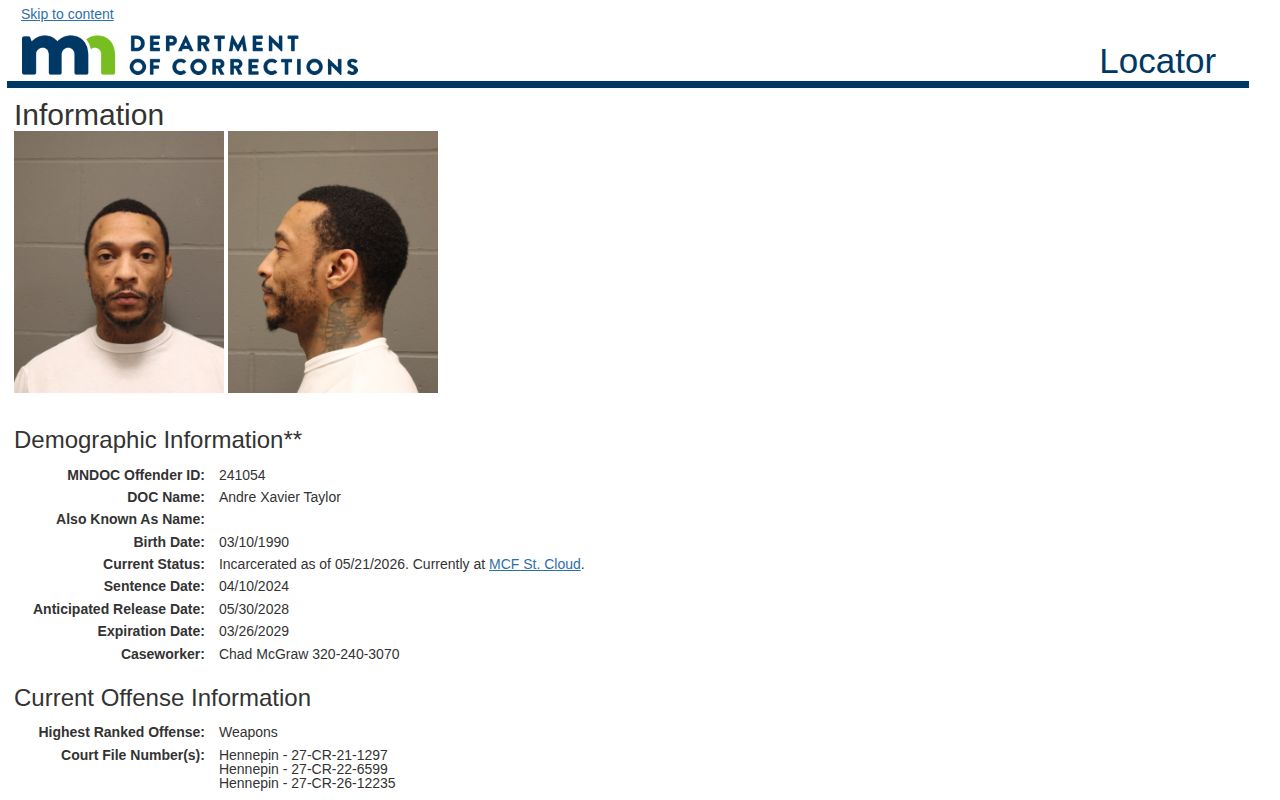
The image reinforces why the forward-looking date, expiration date, current status, and court file should be read as separate parts of one record.
Otter Tail State Sentence Structure
Minnesota’s fixed executed felony framework should not be summarized as an “85 percent” rule. For covered offenses committed on or after August 1, 1993, Minnesota Statutes section 244.101 divides the sentence into a minimum imprisonment term equal to two-thirds and a maximum supervised-release term equal to one-third. The court must explain the total sentence, expected prison portion, expected supervision portion assuming no disciplinary confinement, and the risk that discipline can extend imprisonment.
Section 244.05 likewise sets the supervised-release portion at one-third for the covered fixed sentence, reduced by disciplinary confinement. A person who violates prison rules or refuses required programming can be held past the otherwise expected placement date until the applicable disciplinary or restrictive-confinement period ends. Release to supervision is still part of the executed sentence, not full discharge.
The sentence split does not mean a court can always provide the exact departure date years in advance. DOC applies sentence dates, credit, discipline, concurrent or consecutive terms, and release requirements to the individual record. The court file establishes what was imposed. The corrections record establishes the present calculation and later custody events. When the two appear inconsistent, use the MNDOC ID and court file numbers shown in the Locator to ask DOC Central Records for an explanation.
The official imprisonment and supervised-release statute lays out the baseline calculation.
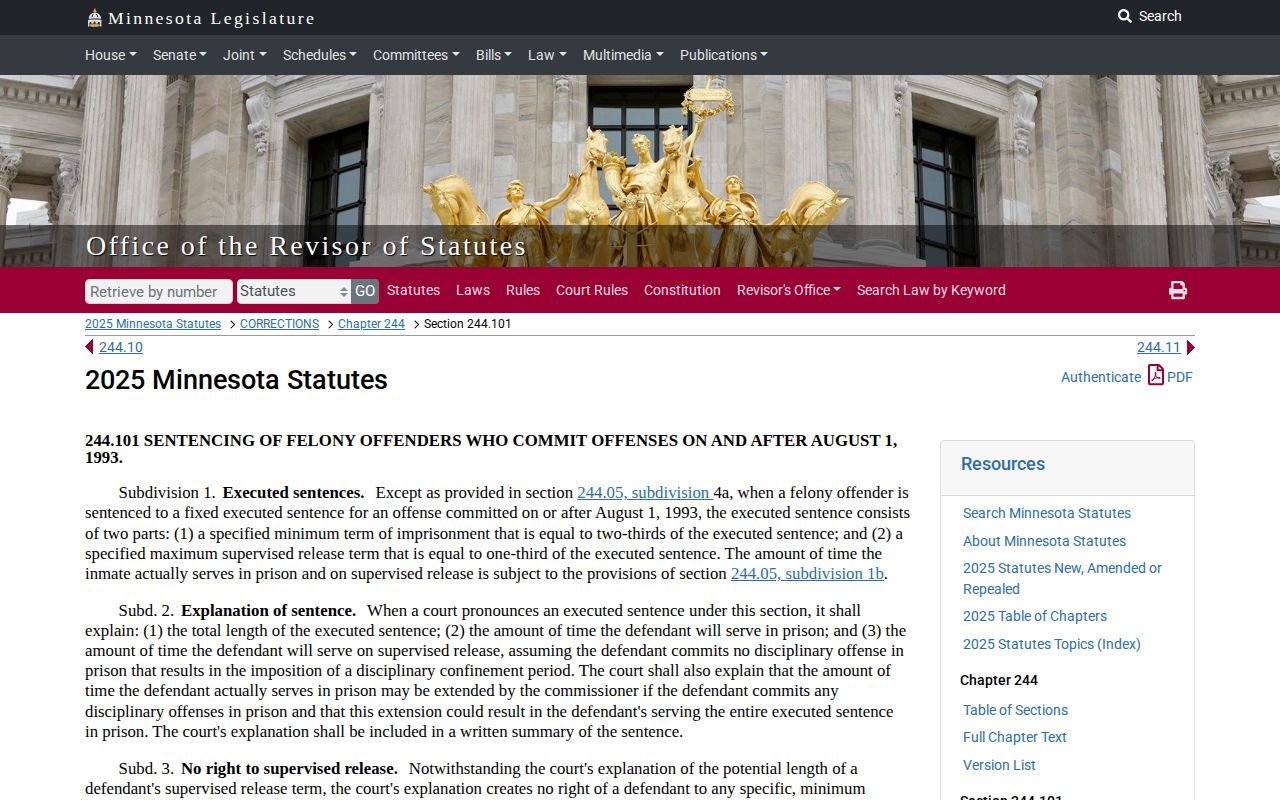
The statutory split explains the broad sentence structure, while the Locator’s Anticipated Release Date remains the public case-specific field to report.
Otter Tail Earned Release Credit
Minnesota’s earned incentive release credit is another case-specific input. Section 244.41 defines it as credit earned through objectives in an individual rehabilitation plan. Section 244.43 directs the corrections commissioner to establish the policy. Under section 244.44, eligible credit reduces the imprisonment calculation but does not add to the supervised-release term.
The maximum reduction is 17 percent of the total executed sentence, and imprisonment may not fall below one-half of that sentence. Credit can be revoked for a facility-rule violation or a criminal act while incarcerated. These are statutory limits, not a promise that every prisoner receives the maximum. Eligibility, completed plan goals, offense and sentence rules, discipline, and the current DOC calculation all matter.
For that reason, do not compute an Otter Tail County person’s date from sentence length and the maximum percentage. Use the date published for that individual and ask DOC for an explanation when the record changes. The original court sentence remains important, but it cannot show later prison credit by itself.
Note: Earned credit can change the prison calculation without making the displayed sentence Expiration Date the same as release.
Why Otter Tail Dates Change
Projected dates move when legal or correctional inputs change. Some changes affect the amount of time served. Others do not change the sentence but prevent a person from entering the community. The record should name the actual factor; a later date should not be assigned to “bad time” or a hold without evidence.
| Factor | Possible effect | Best confirmation source |
|---|---|---|
| Earned incentive credit | May reduce the prison calculation for an eligible person | DOC status and sentence explanation |
| Discipline or lost credit | May delay supervised release or revoke earned credit | DOC record or facility response |
| Court order or amended sentence | May change custody authority or sentence terms | District court register and filed order |
| Detainer or other hold | May cause transfer instead of community release | Jail or DOC release/transfer record and receiving agency |
| Consecutive sentence | May begin another term instead of ending custody | Court file, DOC sentence record, or Board decision |
| Release-plan condition | May delay a Board-eligible release until conditions are met | Board record and DOC current status |
Probation and supervised-release violations also need care. A warrant or alleged violation does not by itself prove revocation. Minnesota law permits changed terms, other interventions, or revocation in covered cases. Look for the resulting order or corrections action and then recheck custody.
Minnesota Weekend Release Timing
Minnesota has an unusual state-prison rule for certain scheduled supervised releases. Section 244.05, subdivision 1a draws a line based on the offense date. For a crime before August 1, 1992, a release scheduled for Friday, Saturday, Sunday, or a holiday starts on the last prior day that is not one of those days. For a crime on or after August 1, 1992, it starts on the first following day that is not Friday, Saturday, Sunday, or a holiday.
This rule belongs to Minnesota state-prison supervised release. It does not prove how Otter Tail County Jail computes each local sentence or when staff complete local release steps. The county publishes no general local calculation policy beside the roster. Ask the jail about the individual projected date and use the actual release record afterward.
Confirm Otter Tail Actual Release
When the projected date approaches, a person-specific VINE alert may provide notice of an offered custody change. The Otter Tail County VINELink release check explains registration and the four-digit telephone PIN. An alert is still a prompt to verify. Delivery can lag, and an agency-reported release may need a second record to distinguish community departure from transfer.
For the county jail, seek the Sheriff’s actual date, time, legal basis, destination or receiving agency, and hold outcome. Minnesota Statutes section 13.82 expressly treats enumerated release and transfer facts as public arrest data. For state prison, read the new Current Status, Last Release Date when present, supervising agency, and Expiration Date, then ask DOC Records for the maintained record if the public display is unclear.
Final discharge is yet another event. Minnesota law recognizes that active supervision can abate without changing the legal expiration date. A person can therefore stop routine reporting before every legal part of the sentence ends. Report projected release, physical release, supervision, expiration, and final discharge as distinct facts.
For a fully discharged state case that no longer appears in the Locator, use Minnesota DOC Data Practices. Ask for existing records showing actual release date, release status, expiration or final discharge, MNDOC ID, and links to the sentence and court files. DOC Records Management lists 651-361-7330, fax 612-473-5006, and CO-Records.DOC@state.mn.us. A records response can resolve a historical date that a current-jurisdiction search no longer displays.
For an Otter Tail County sentence, the formal county request should name the booking episode and seek the actual release or transfer data. Include full name, date of birth, MNI number, booking number, and approximate intake date when known. Ask for public portions even if other detention data require redaction. This route documents what occurred without asking staff to calculate a new date or create a report the county does not maintain.